
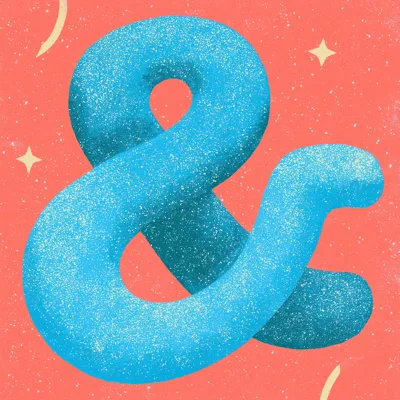
The ampersand was once the 27th letter of the alphabet
How “and per se and” collapsed into the word “ampersand” — and why the symbol itself is a 2,000-year-old shorthand for the Latin word for “and.”
Look closely at an ampersand, &, and you can almost see two letters holding hands. You actually are: it's a ligature, two letters squished into one. The letters are e and t, spelling et, Latin for “and.”
Roman scribes wrote et constantly, and like anyone writing the same tiny word all day, they started running the strokes together. By the first century their cursive was already looping the e into the t, and after centuries of copying, the join settled into the shape we use today.
The etymology of “ampersand”
Through most of the 1800s, & was the last letter of the alphabet, printed right after Z and called simply “and.”
For letters that were also words, like and, a, and I, people said the Latin per se (“by itself,” from per + se) first to signal you meant the letter. So reciting the alphabet would end “…X, Y, Z, and per se and.” Over time, that last stretch slurred into a single word: ampersand.
English does this a lot. “Goodbye” is a compressed “God be with ye,” and the “o'” in “o'clock” is all that survives of “of the clock.”
An old symbol, a young word
The two halves of this story are wildly far apart. The symbol is ancient, a piece of shorthand nearly two millennia old. The word “ampersand” is a teenager by comparison, not showing up in print until the 1830s. For most of its life the & had no English name at all. You just drew it, and everyone knew what you meant.
Today the ampersand has quietly slipped out of the alphabet again and back into punctuation — but it's still the rare character on your keyboard whose name is a fossilized sentence, and whose shape is a word from a dead language.